





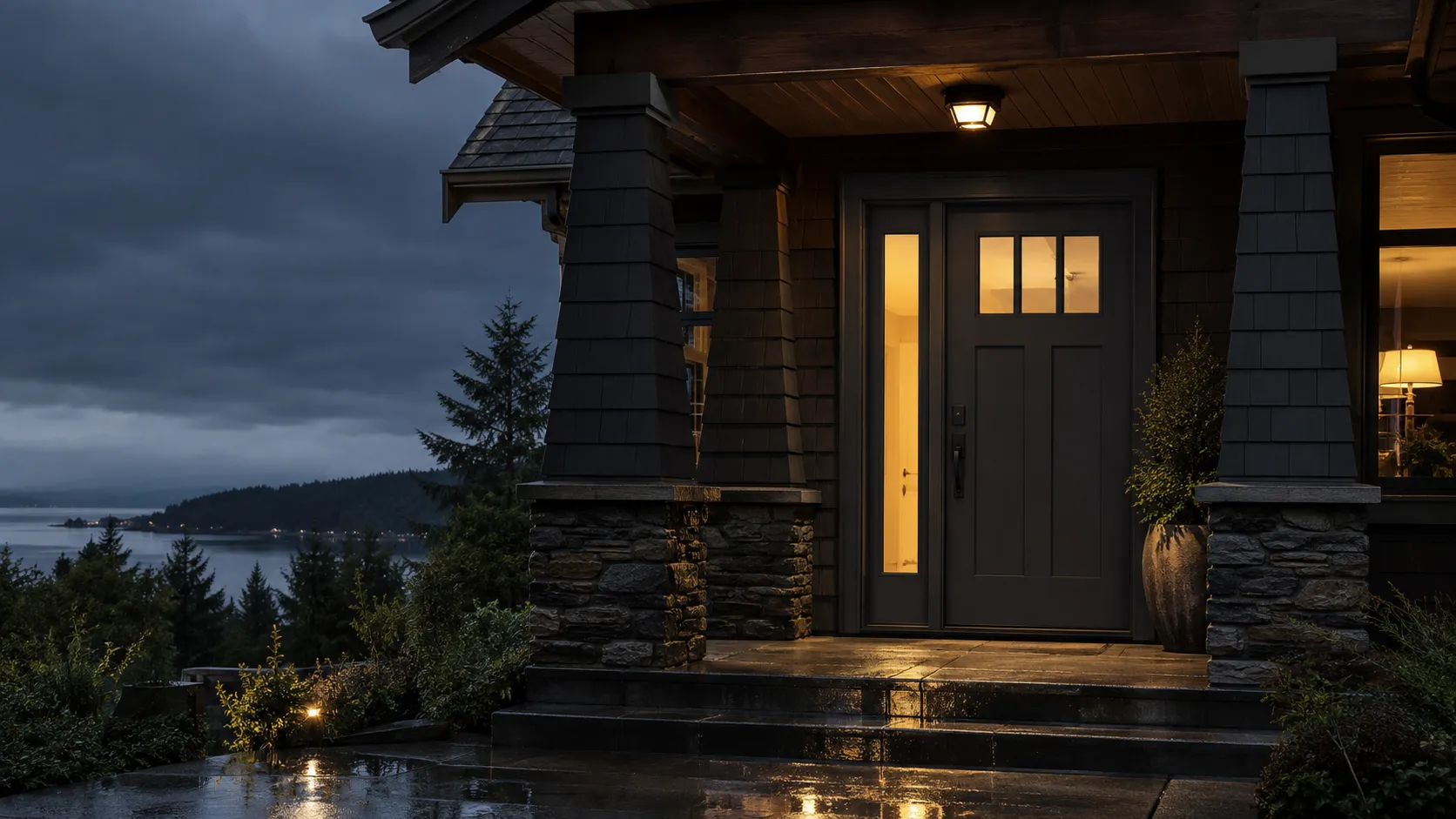
Every month we get calls that start the same way: “The door’s been sticking for a while — can you just fix it?” Sometimes we can point someone toward a simple fix. More often, we find that what looked like a sticking door is actually a failing frame, a seal that hasn’t worked in years, and a rough opening that’s been accumulating moisture damage behind the trim. At that point, repair is not a solution — it’s a delay.
This guide gives you the honest answer. When repair is a real option. When it isn’t. And why BC’s coastal climate means the line between the two comes sooner than most homeowners expect.
Why BC is harder on doors than most of Canada
Greater Vancouver averages over 1,150mm of rain per year. Combined with coastal humidity, salt air in areas like Richmond and Kitsilano, and the freeze-thaw cycles between November and March, exterior doors here face conditions that would be considered extreme in Alberta or Ontario.
The practical result: wooden door frames that might last 15–20 years in drier climates often show significant rot damage in BC within 8–10 years. Weatherstripping compresses and fails faster under sustained moisture pressure. Hardware corrodes. Seals that were adequate when installed stop performing.
What this means for your decision
A repair that would make sense on a 5-year-old door in Calgary may not make sense on a 10-year-old door in Burnaby. The underlying deterioration has usually progressed further than it looks from outside.
Signs that repair is a legitimate option
Repair genuinely makes sense in a limited set of situations. If your door is less than 5–6 years old, was properly installed as a complete system, and the problem is isolated to a single component, repair can extend its life meaningfully.
- Weatherstripping only: If the seal is the only issue — visible compression, a draught you can feel at a specific point — replacing the weatherstripping is a legitimate fix. It costs $50–150 in materials and a few hours. It works if the frame is sound and the door itself seals properly when you push it firmly closed.
- Hardware failure: A worn latch, a hinge that has pulled slightly from the frame, a lock cylinder that is stiffening — these are component failures, not system failures. Repair is appropriate if the door itself is structurally sound.
- Minor adjustment: A door that is slightly out of square due to seasonal wood movement can sometimes be rehung or shimmed. This is installer work, not a simple DIY fix, but it is repair.
Signs that replacement is the right answer
These are the situations we see most often. In every case, repair would be temporary at best — and in some cases, it would make the underlying problem worse by hiding it.
Frame damage or rot
This is the most common reason we replace doors in BC rather than repair them. The frame — the structural element the door hangs in — is often more deteriorated than the door itself. You may not see it from outside. The rot is typically behind the trim, in the rough opening, at the sill plate.
How to check: look at the bottom corners of the door frame, inside and out. Press the wood with a screwdriver. If it goes in easily, or if the wood is soft and dark, there is rot. Once the frame is compromised, no amount of weatherstripping replacement or adjustment will restore the seal — the geometry of the opening has changed.

The hidden rot problem in BC
In our installations across Greater Vancouver, we find hidden frame damage in a significant share of replacements — damage that wasn’t visible from outside and that the homeowner didn’t know was there. If your door has been leaking or drafting for more than a year, assume there is frame damage until proven otherwise.
Persistent draught despite new weatherstripping
If you’ve already replaced the weatherstripping and the draught returned within a season, the problem is not the seal — it’s the frame. A warped, rotted, or out-of-square frame cannot hold a seal regardless of weatherstripping quality. Replacement is the only lasting fix.
Visible damage to the door slab itself
A delaminating fiberglass door, a steel door with through-rust, a wood door with significant warping — these are not repairable in any meaningful sense. The structural integrity of the door slab is gone. A patch or refinish will not restore thermal performance or sealing ability.
Door is more than 15 years old
In BC’s climate, a 15-year-old exterior door is near or past the end of its effective service life. The insulation has degraded, the seals have compressed permanently, and the hardware is likely worn. Even if it still opens and closes, its thermal and weather performance is a fraction of what a new installation would deliver. Repair at this stage is spending money to delay an inevitable replacement.
Door, frame, seals, and hardware replaced as one complete system.
The repair vs replace decision — quick reference
| Situation | Repair? | Replace? |
|---|---|---|
| Weatherstripping worn, frame sound, door < 6 yrs | ✓ Repair | — |
| Hardware failure: latch, hinge, or lock | ✓ Repair | — |
| Minor adjustment or seasonal movement | ✓ Repair | — |
| Draught returned after weatherstripping replacement | — | ✓ Replace |
| Soft or dark wood at frame corners | — | ✓ Replace |
| Door slab delaminating, warped, or rusting through | — | ✓ Replace |
| Door 15+ years old in BC climate | — | ✓ Replace |
| Water visible at sill or threshold after rain | — | ✓ Replace |
| Persistent cold spot despite no visible gap | — | ✓ Replace |
What a proper replacement actually involves
This matters because many homeowners have had a door “replaced” that was not really — just the slab swapped, the old frame left in place, the moisture damage behind the trim untouched. That is not a replacement. That is a delay with a new face on it.
A complete door replacement means: removing the old door and frame entirely, opening up the rough opening and inspecting it for rot and moisture damage, addressing what we find before the new door goes in, installing the new unit as a sealed system with proper flashing at the head and sill, a moisture barrier behind the frame, and a full perimeter seal. Then testing it.
“We found rot in the frame we didn’t know about — they fixed it before putting the new door in. No surprise charges. The cold spot in the hallway is completely gone after the first night.”
— [Name] · East Vancouver · Steel Entry Door replacementIf you’ve been told you just need new weatherstripping, and the door has been drafting for more than a year, get a second opinion. In BC’s climate, a year of drafting almost always means frame damage — and frame damage means replacement, not repair.
The cost question
Repair is cheaper upfront. A weatherstripping replacement runs $100–300 including labour. A hardware fix might be similar. A full door and frame replacement in Greater Vancouver — door, labour, frame work — is a more significant investment.
But the comparison only holds if repair actually solves the problem. If you repair weatherstripping on a failing frame, you’ll be back in 12–18 months with the same issue, plus the frame damage will have progressed. The total cost of two repairs plus an eventual replacement is higher than one replacement done at the right time.
What drives the price and why quotes vary between companies.
Read the guide
How to get an honest answer
The only way to know for certain whether your door needs repair or replacement is a proper inspection — which means someone physically checking the frame, not just looking at the door from outside. We do this as part of our free in-home estimate. We’ll tell you what we find, explain the options, and give you a flat-rate quote if replacement makes sense. If it doesn’t, we’ll tell you that too.
There’s no deposit, no obligation, and no pressure. If repair is genuinely the right answer for your situation, that’s what we’ll say.